
13/2026
2026-04-13
Openness about Pay
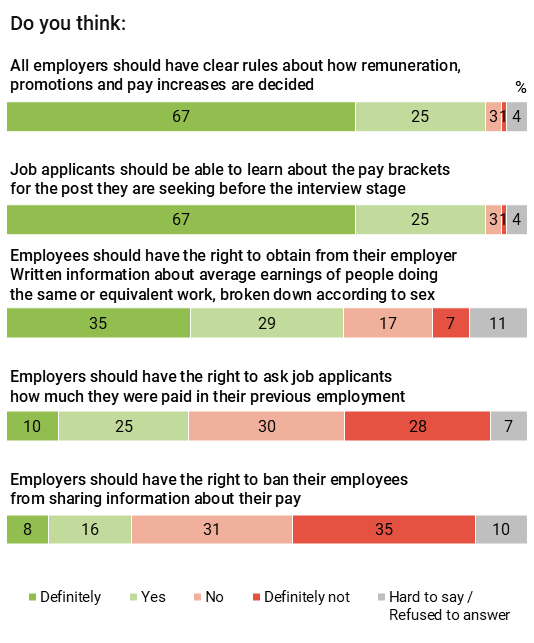
All the people surveyed, regardless of whether they had ever had paid work, were asked five questions relating to issues of openness about pay. Respondents were most strongly in favour of employers having to have clear rules about how salary levels, promotions and pay increases are decided and of job applicants being able know the pay brackets for the post they are seeking before they get to the interview stage (92% and 67% respectively). Almost two thirds of respondents (64%) thought that employees should be able to get from their employer written information about average earnings of people doing the same or equivalent work, broken down according to sex. A majority were of the opinion that employers should not be able to ban their employees from sharing information about their pay (66%) or ask job applicants about previous pay (58%).
|
Respondents’ opinions were generally in keeping with the amendments to the Polish Labour Code passed on 4 June 2025, which had been prompted by an EU Parliament and Council directive (2023/970 of 10 May 2023) aimed at reinforcing the principle of equal remuneration for men and women doing the same work or work of equal value, using remuneration transparency and enforcement mechanisms.
More on this subject in the CBOS report.
This ‘Current Events and Problems’ survey (431) was conducted using a mixed-mode procedure on a representative sample of named adult residents of Poland, randomly selected from the National Identity Number (PESEL) register. Respondents independently selected one of the following methods: Computer Assisted Personal Interview (CAPI); Computer Assisted Telephone Interview (CATI), respondents receiving researchers’ telephone numbers in an introductory letter from CBOS; Computer Assisted Web Interview (CAWI), where respondents filled in the online questionnaire independently, gaining access by means of a login and password provided in an introductory letter from CBOS. In all three cases the questionnaire had the same structure and comprised the same questions. The survey was carried out between 5 – 15 March 2026 inclusive on a sample of 1012 people (64.4% using the CAPI method, 20.2% CATI and 15.4% CAWI). CBOS has been conducting statutory research using the above procedure since May 2020, stating in each case the percentage of personal, telephone and internet interviews.