
20/2026
2026-07-22
What Poles Think about Limiting Benefits for Ukrainians with Small Children
July has seen the implementation of new provisions of the parliamentary act limiting Polish state help for Ukrainians affected by the war in their country. Now mothers of children over the age of one are facing the withdrawal of the benefit that covers their stay in collective accommodation.
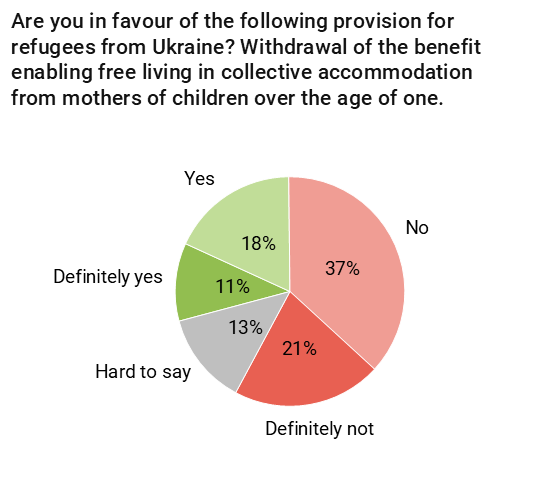
Most of the people CBOS surveyed were critical of limiting the chance of staying for free in collective accommodation to women with children not over the age of one. A solid 58% of respondents were against this provision, with only half this number (29%) being in favour.
|
Attitudes to this change were clearly influenced by political and party allegiances. Opposition to limiting help for women with children over one was most often expressed by people with leftwing views (74%) but those identifying with the centre or the right were also mostly against this provision (59% and 54% respectively).
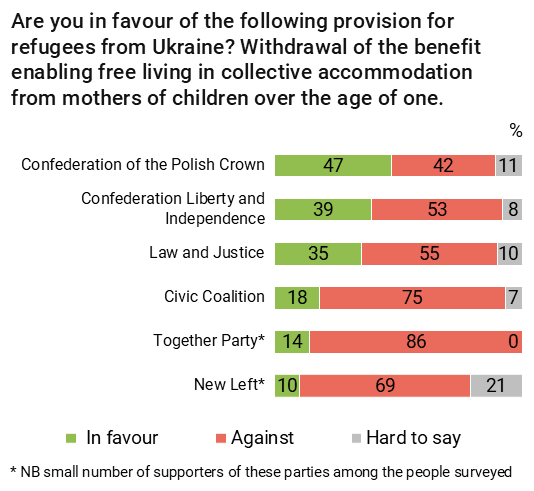
Supporters off the Civic Coalition and the New Left were quite unambiguously against the new ruling, as were the voters of the Together Party. However, over half of Law and Justice and also Confederation Liberty and Independence sympathisers were likewise opposed. It was only among the potential voters for the Confederation of the Polish Crown that approval for this provision was dominant.
|
More on this subject in the CBOS report.
This ‘Current Events and Problems’ survey (435) was conducted using a mixed-mode procedure on a representative sample of named adult residents of Poland, randomly selected from the National Identity Number (PESEL) register. Respondents independently selected one of the following methods: Computer Assisted Personal Interview (CAPI); Computer Assisted Telephone Interview (CATI), respondents receiving researchers’ telephone numbers in an introductory letter from CBOS; Computer Assisted Web Interview (CAWI), where respondents filled in the online questionnaire independently, gaining access by means of a login and password provided in an introductory letter from CBOS. In all three cases the questionnaire had the same structure and comprised the same questions. The survey was carried out between 2 – 12 July 2026 inclusive on a sample of 938 people (65.5% using the CAPI method, 16.6% CATI and 17.9% CAWI). CBOS has been conducting statutory research using the above procedure since May 2020, stating in each case the percentage of personal, telephone and internet interviews.