

29/2025
2025-12-16
Polish Senior Citizens in 2025
The elderly population in Poland has been steadily increasing for almost twenty years. In 2005 people aged 60 or over accounted for 17.2% of the general population, by 2024 this was 26.6% and now Statistics Poland predict that by 2060 the proportion will be 38.3%. The dynamic pace of this change prompts reflection about aging populations and how older people function. This year, after a gap of almost a decade, CBOS has conducted two surveys, asking people aged 60+ how they spend their time and how they rate their health.
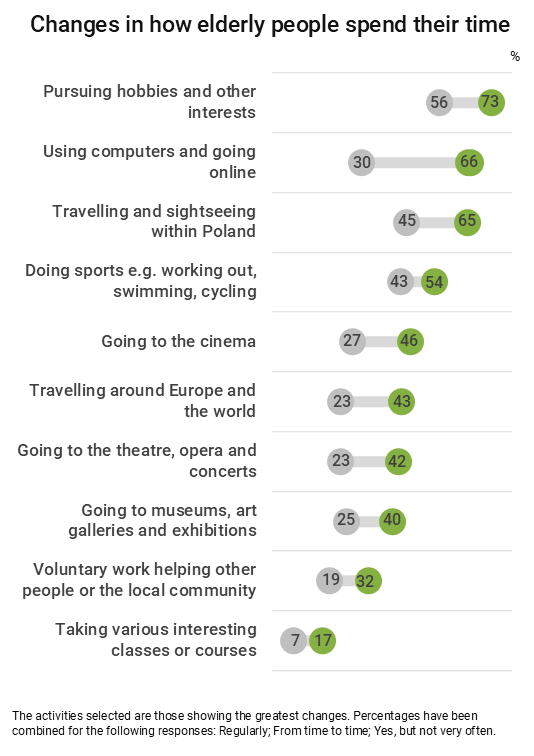
Over the last decade there have been notable changes in how Polish senior citizens spend their time, with an increase in the variety of activities they undertake. Most notably many more over-60s are computer and internet users: since 2016 the proportion has more than doubled from 30% to 66%. The elderly are now more likely to travel and visit various destinations in Poland (a rise from 45% to 65%) and around Europe and the world (from 23% to 43%). Their participation in cultural events has also risen: there has been significant growth in the proportion who go to the cinema (from 27% to 46%), the theatre, opera or concerts (from 23% to 42%) and museums, galleries and exhibitions (from 25% to 40%). More older people now spend time on their hobbies or pursuing their interests (up from 56% to 73%), go to classes or take courses (7% to 17%) or practise sports (43% to 54%). Their participation in voluntary and community work is also up from 19% to 32%.
|
More on this subject in the CBOS report.
Two ‘Current Events and Problems’ surveys (423 and 424) have been combined. Both were conducted using a mixed-mode procedure on a representative sample of named adult residents of Poland, randomly selected from the National Identity Number (PESEL) register. The first survey (423) was carried out between 3 – 13 July 2025 inclusive on a sample of 970 people (65.5% using the CAPI method, 19.7% CATI and 14.8% CAWI). The second survey (424) was carried out between 21 August – 1 September 2025 inclusive on a sample of 917 people (64.6% using the CAPI method, 18.8% CATI and 16.7% CAWI). In total, the study included 744 individuals aged 60 and over.