

When youth ends and old age begins
Author: Małgorzata Omyła-Rudzka
|
2026-06-18
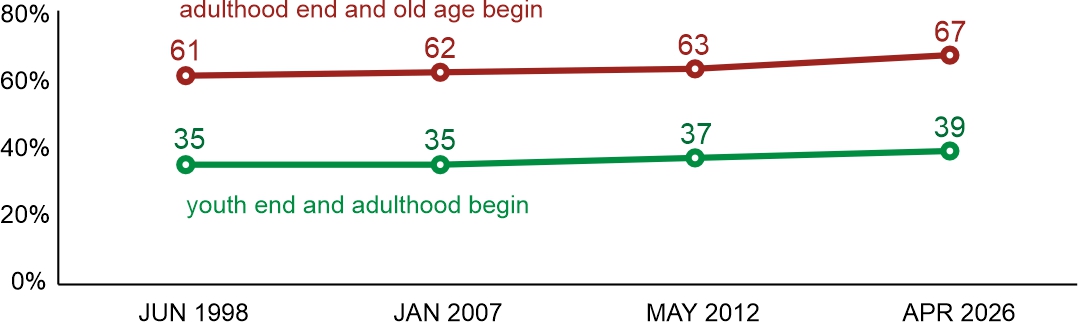
Estimates regarding the periodization of individual life stages indicate that youth lasts until approximately age 39. From this point on, middle age begins, lasting approximately until the age of 67, and after this age, respondents believe old age begins. Compared to the 2012 survey, the end of youth is perceived by society two years later, and the threshold of old age four years later. Considering a longer timeframe of nearly thirty years, we can see that the socially established threshold of youth has shifted by four years, while that of old age by as much as six years.
Approximately at what age does…
Average age in years
Average age in years
The perception of the boundaries between individual life stages largely depends on the age of respondents. Generally speaking, older people believe that both the end of youth and the beginning of old age occur later than younger people. According to the youngest respondents (aged 18 to 24), youth ends on average at age 31, and with age, this boundary shifts to 42 among the oldest respondents, at age 65 or older. Old age, according to the youngest respondents (aged 18 to 24), begins at age 61, while for the oldest respondents (aged 65 or older), it begins seven years later, at 68.
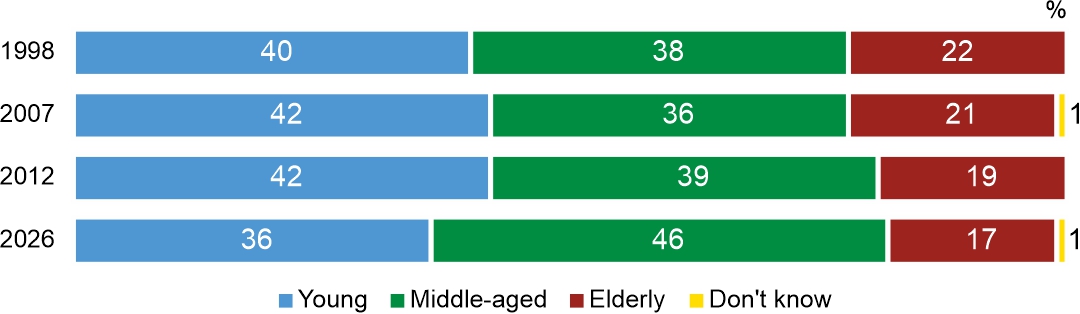
Declarations indicate that just over one-third of adult Poles (36%) consider themselves young, almost half (46%) think they are middle-aged, and nearly one-fifth (17%) consider themselves elderly. Compared to 2012, the share of people who think of themselves as middle-aged has significantly increased, while the percentage of those who consider themselves young has decreased from 42% to 36%. There is also s small decrease in the number of people who consider themselves as seniors (from 19% to 17%). This is surprising, considering that over the past two decades, the percentage of people aged 60+ in Polish society has been increasing. However, our research shows that since 2007, the share of respondents who consider themselves older has actually decreased (17% in 2026, compared to 19% in 2012 and 21% in 2007).
Considering your age, would you consider yourself young, middle-aged, or elderly?
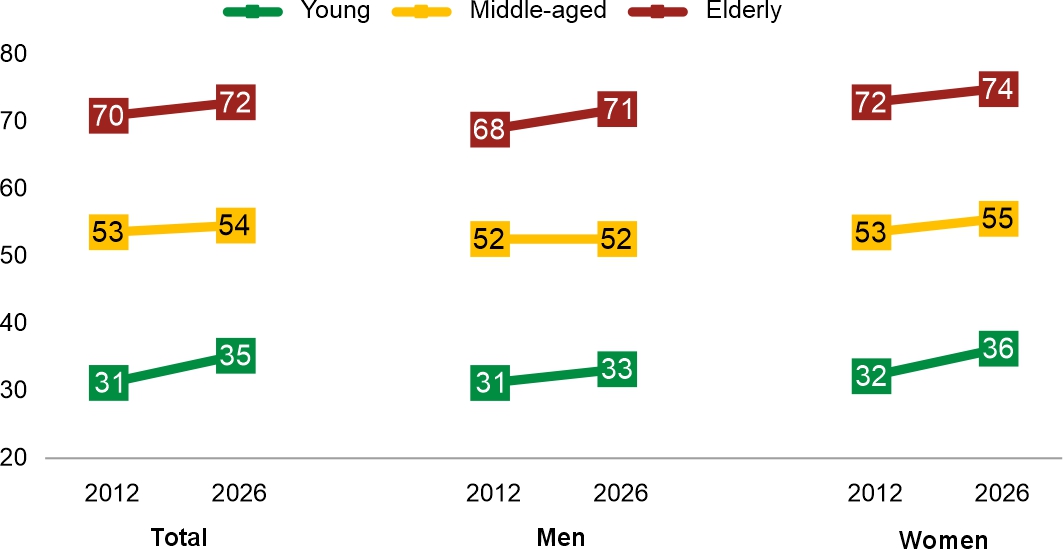
The vast majority of people under 40 consider themselves young. Respondents aged 40–64 typically think of themselves as middle-aged. However, the opinions of those aged 65–69 are very divided – they are almost as likely to consider themselves middle-aged as seniors. People aged 70+, on the other hand, usually think they are old. The average age of respondents who consider themselves young is currently 35, for the middle-aged it is 54, and for the elderly it is 72. These averages are higher among women than among men, meaning women consider themselves young longer and recognize that they have entered old age later.
Considering your age, would you consider yourself young, middle-aged, or elderly?
We were also interested in determining at what point in life the belief that the best things in life are behind us begins to prevail, and how long do we still maintain the hope that many good things can happen in our lives. Generally, the vast majority of adults believe that many good things can still happen (74%), while those who think that the best is probably behind them are in the minority (20%). What's particularly important is that over the last ten years, despite the aging population, the percentage of people who believe that the best is behind them has actually slightly decreased from 24% to 20%.
More information about this topic can be found in CBOS report in Polish: "When youth ends and old age begins?", June 2026. Fieldwork for national sample: April 2026, N=944. The random sample is representative for adult population of Poland.