

The use of artificial intelligence
Authors: Daria Litwin, Zuzanna Czarnecka
|
2026-06-24
We were also interested in how often and for what purposes Poles themselves use generative AI tools (such as ChatGPT, Copilot, or Gemini). As it turned out, although artificial intelligence is increasingly embedded in our daily lives, the use of generative AI tools is not yet widespread – almost two-thirds of respondents (64%) declared that they had not used such tools in the last three months.
Have you used generative artificial intelligence (AI) tools in the last three months?

"Don't know" responses omitted.
The most frequent users of generative AI are by far people aged 18 to 24 (81%). Among those aged 35 to 44, only half (51%) of respondents use it, and among seniors, fewer than one in ten (8%).
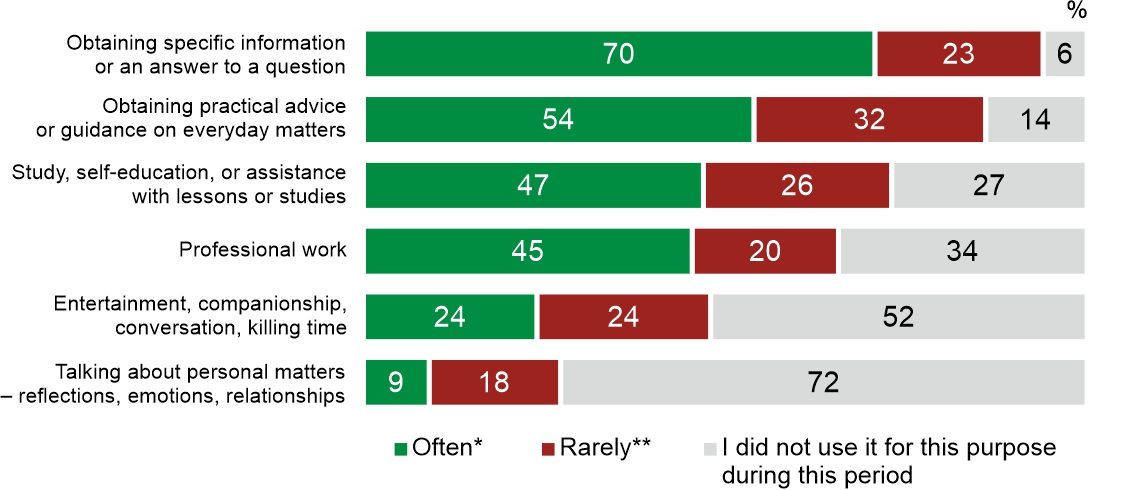
We presented respondents with six potential applications of generative AI tools and asked them to indicate how often they used them. The responses indicate that AI is most often used as an information source. Seven in ten (70%) said they frequently used AI to obtain specific information or an answer to a question in the last three months, with a quarter (25%) doing so daily or almost daily.
Please indicate how often you used AI for this purpose in the last three months.
Responses from people who declared using AI tools:
Responses from people who declared using AI tools:
*Responses "every day or almost every day" and "at least once a week (but not every day)" combined;
**Responses "at least once a month (but not every week)" and "less than once a month" combined;
Percentages do not add up to 100 due to rounding.
**Responses "at least once a month (but not every week)" and "less than once a month" combined;
Percentages do not add up to 100 due to rounding.
Another purpose for which AI was used relatively frequently was obtaining advice or practical tips on everyday matters, such as cooking, travel, organization, or finances (54%). Furthermore, almost half of generative AI users found it convenient for learning or self-education (47%) and for professional work (45%). Not surprisingly, students are particularly prevalent in the former category: 84% of them used AI for this purpose at least once a week, with 40% doing so daily. The most frequent users of AI for professional purposes were the self-employed (77%), managers and specialists with higher education (65%), mid-level staff and technicians (61%), and administrative and office workers (51%).
Fewer respondents reported frequent use of AI for entertainment, companionship, conversation, or to pass the time (24%). Interestingly, seniors clearly stand out in this regard (43%). Frequent use of AI to discuss personal matters, such as emotions, reflections, or relationships (9%) is least common. Again, we encountered such statements more frequently among those aged 65 and older (17%) than among the general population.
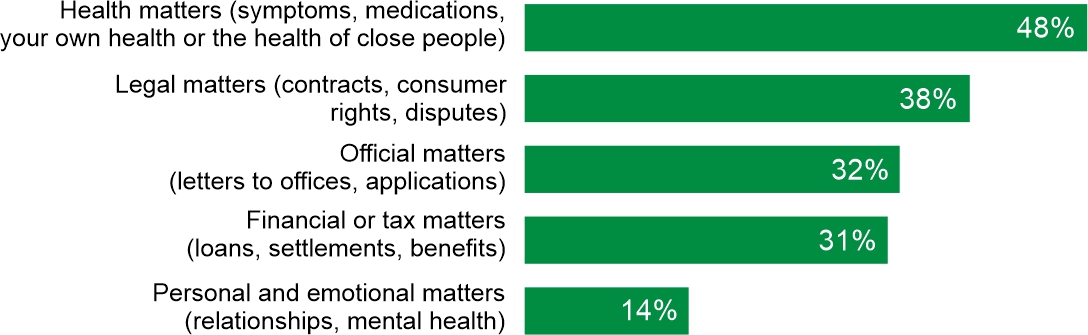
We were also interested in what matters Poles had consulted AI about in the last three months. The most common response was obtaining information related to health (48%). Respondents were slightly less likely to use AI advice on legal (38%), official (32%), and financial (31%) matters. Only one in seven (14%) reported recently using AI to obtain advice on personal and emotional matters, such as mental health or relationships.
In the last three months, have you used artificial intelligence (AI) to obtain information or advice on any of the following matters?
Affirmative answers by those who declared using AI tools:
Affirmative answers by those who declared using AI tools:
More information about this topic can be found in CBOS report in Polish: "The use of artificial intelligence", June 2026. Fieldwork for national sample: May 2026, N=1041. The random sample is representative for adult population of Poland.